Making UX Standards an AI Agent Can Actually Read
Turning years of interface debt into one coherent system, right as engineering started shipping through AI agents.
About this project
A long running healthcare compliance product had grown over many years. As the company expanded into new tools, each one got built separately. At the same time, engineering started using AI coding agents to ship faster. That speed was genuinely good. It also meant a growing risk of inconsistent patterns and fragmented workflows, multiplied across every new tool being built this way.
My job was to bring the experience back into one coherent system, and to make the standards easy for both humans and AI agents to actually follow.
Role: Product Designer (UX/UI)
Work: UX audit, design system strategy, AI ready documentation
💡Why this mattered
Multiple products, each one built separately, by different teams, at different times. Engineering teams increasingly shipping UI through autonomous coding agents instead of writing every line by hand. And underneath all of it, users working with sensitive compliance data, where a confusing interface isn't just annoying, it's a real chance for a costly mistake.
Speed was already happening. The only real question was whether that speed would come with consistency, or against it.
Years of design and technical shortcuts made the product harder to learn and maintain.
Every new tool got its own layout and components
AI agents introducing new patterns nobody asked for, without guardrails
The original product carried years of design and technical shortcuts that made it harder to learn and maintain. Every new tool the company built got its own layout and components, so the suite felt like a handful of separate products.
None of this was any one team's fault. Nobody had written down what "consistent" actually meant in a way that scaled.
Job to be done

“As a developer shipping through an AI coding agent, I want the agent to already know our UX rules, so I’m not stuck catching every inconsistency after the fact.”
My hypothesis
If UX standards were written in a format both people and AI agents could read and follow, we could scale consistency without slowing anyone down.
The process
The questions that actually shaped this
How might we let people move between tools without relearning the interface?
How might we turn UX judgment into something an AI agent can actually follow?
How might we keep shipping without quietly reintroducing inconsistency?
What “working” would actually look like
Users feel oriented no matter which tool they’re using
Reusable patterns exist for the highest stakes workflows
AI agents produce interface code that already matches standards
Teams keep shipping fast, without trading away consistency
Discovery and audit first
I did an ecosystem deep dive to understand the each applications, built a full interface inventory across the suite, and used the resulting pattern matrix to prioritize what needed fixing first.

Defining a small, suite wide framework
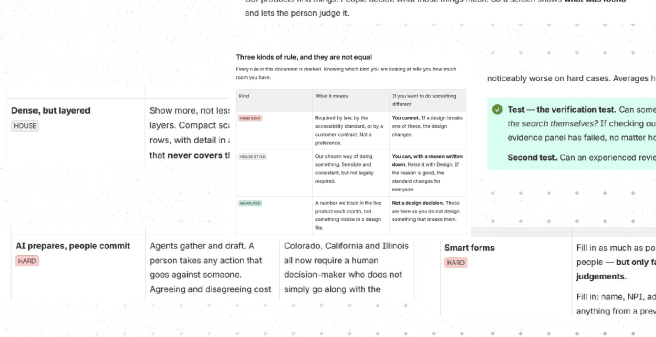
From the audit, I built a handful of patterns meant to scale across every product: it includes different rules (hard rule, house style and measured) that define if something can be skip or not.
I also compiled numbers of UX patterns that every app should follow: such as how the forms should be presented, how should AI suggestions should behave, the language that the app should use, what should prioritize if ever one or more rules conflicts.

Making the standards legible to AI agents, not just people
This is the part that actually prevents drift going forward.
I wrote an AI ready UX standards guide, structured like a system file an agent could read before writing any interface code, with concrete rules and examples rather than general principles.

Teams could ship new features faster, with fewer UX regressions, since the core patterns already existed instead of getting reinvented per feature.
People moving between tools in the suite carried less cognitive load.
And the AI ready guardrails measurably reduced the drift that autonomous coding agents had started introducing before any of this existed.
“The AI agent had become a stakeholder in its own right, one that needed documentation as much as any new hire would”
AI genuinely speeds up shipping. It also quietly amplifies inconsistency the moment your standards aren't clear enough for a machine to follow, not just a person.
The real shift for me here wasn't the patterns themselves, it was realizing that "the AI agent" had become a stakeholder in its own right, one that needed documentation as much as any new hire would. Once I started writing UX standards for two audiences instead of one, human and agent, the whole system got a lot more durable.